Showing posts with label John Blandford Armstrong. Show all posts

Sunday, November 10, 2013

Nov. 10, 1943 Silver Star

     John B. Armstrong didn't talk about his war experiences much. When he was interviewed by his grandson, Daniel, he barely mentioned why he received a Silver Star.  He told Dan, "...The next day my regimental commander sent me forward to investigate because another company had been isolated and because of this he gave me a Silver Star."
     About 10-12 years later when he was interviewed by another grandson, Tony wrote "he was commanded to find out what was causing the communication problem after her rejoined his battalion south of Cassino near Mignano…He had to go over ditches and through trenches where he had to climb over dead bodies while the enemy was dropping motor shells all around. He reestablished communications and that is why he received the Silver Star."
     I think he minimized his gallantry. The following is taken from the official record of his award:
          *  *  *  *         E_X_T_R_A_C_T          *  *  *  * 
     I - AWARD OF THE SILVER STAR.  Under the provisions of Armsy Regulations 600-45, a Silver Star is awarded the following named officer:
JOHN B. ARMSTRONG, O-354947, First Lieutenant, 15th Infantry. For gallantry in action. On 10 November 1943, near Mignano, Italy. Lieutenant ARMSTRONG, with complete disregard for his personal safety, crossed 1000 yards of open field, exposing himself for two hours to heavy small arms, mortar, and artillery fire, with shell fragments and bullets striking within 10 yards of him, in order to reach a company which was not in contact with the battalion.  Upon reaching the company he found it under artillery and motor fire. Displaying exemplary courage, he aided in reorganizing the company and the reestablishment of its communications, reporting the situation to the Battalion Commander.  His gallant actions were instrumental in the formation of necessary plans for the company to proceed to its objective. Residence at appointment: Los Angeles, California.
                *  *  *  *         E_X_T_R_A_C_T          *  *  *  * 
                By command of Major General TRUSCOTT


Probable movement of Lt. John B. Armstrong at the Battle of the Mignano Gap1


"Across the Volturno - US Army Center Of Military History." 2007. 10 Nov. 2013 <http://www.history.army.mil/books/wwii/volturno/volturno-across.htm>

Friday, November 8, 2013

Nov 8 - 11, 1942 - The 15th Infantry Regiment: Fedala to Casablanca

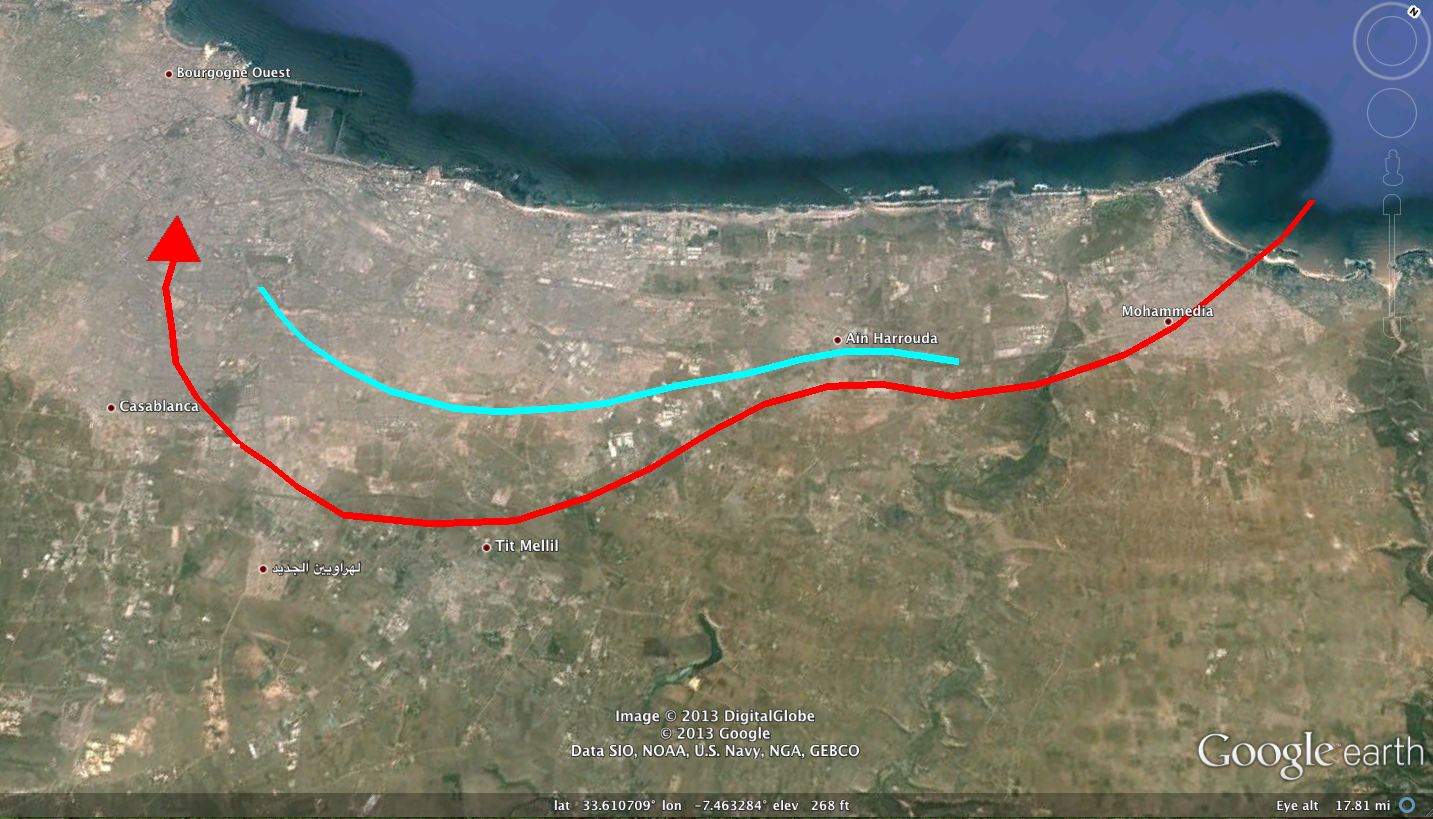
     On Nov. 8, 1942 the United States attacked the beaches near Casablanca.  The Third Division came on shore sixteen miles north of Casablanca at Fedala. Lt. John B. Armstrong was part of the 15th Infantry Regiment. The path of the 15th Regiment is shown as a red line on the adjacent maps.  The blue line represents the border between the 7th Regiment and the 15th Regiment.  I  took that map and used it as an overlay on Google Earth. then after removing the overlay I can see the path taken by the 15th Regiment.  
     From November 8 - 11 the Third Division advanced towards Casablanca.  On Nov 11, the Vichy French surrendered.   The next few months saw the third division stay in this region until they were needed at Tunisia.

Map from the History of the Third Division in World War II 1
Google Earth with previous map overlaid on top 2
Google Earth showing path of 15th Regiment 3
A map showing the Terrain 4
1.  Taggart, Donald, History of the Third Infantry Division in World War II, Battery Press, Nashville. 1987

2. Google Earth." 2005. 7 Nov. 2013 <http://earth.google.com/>

3. Google Earth." 2005. 7 Nov. 2013 <http://earth.google.com/>

4.  "Google Maps Engine Lite." 2012. 7 Nov. 2013 <https://mapsengine.google.com/>

Thursday, November 7, 2013

Convoy Zig Zags to Casablanca

     Beginning on October 24,1942, the 3rd Infantry Division, 15th Infantry Regiment sailed from Norfolk, Virginia, bound for French Morocco.  
     On the attached map you can see that this was a joint exercise with the British.   This map is from a British book so it is more detailed about the British portion of the operation.  (The dates are also written in the European style with the day/month so 3/11 = Nov. 3.)  The British passed through the Straights of Gibraltar and landed farther east.  
     The Americans were scheduled to land in the area around Casablanca.  The course followed by the American fleet was designed to make the Germans think that they might have a different objective.  The zig-zag course was also used to avoid the German U-boats.  
     Lt. John B. Armstrong was in the group that was scheduled to land near Fedala at daybreak on Nov. 8, 1942.  Fedala was 16 miles north of Casablanca.  Casablanca was under control of the Vichy French who, of course were under German control. 
       Fedala was the was the first amphibious landing where Lt. Armstrong was a participant.  He also participated at Sicily, Salerno, Anzio, and St. Tropez.  At that point he returned home for some R&R and began training for the invasion of Japan, which thankfully never happened.  


1.  "HyperWar: HyperWar: War at Sea 1939-1945, Vol. II: The ... - Ibiblio." 2005. 6 Nov. 2013 <http://www.ibiblio.org/hyperwar/UN/UK/UK-RN-II/>


Wednesday, November 6, 2013

Camp Pickett, Virginia - Oct 23, 1942

     During the summer of 1942, the Army 3rd Division trained at Fort Ord in preparation for the United States' involvement in World War II.  In September of that year the Lt. John B. Armstrong as a member of the 3rd Division was transferred across the country to Camp Pickett near Blackstone, Virginia.  At Camp Pickett the 3rd Division went through final training for what was then a secret operation.  According to history books only 800 people in the army and government in America and England knew the final objective.
     Word must have trickled down to Elmer John Armstrong, at that time a Major in the Army and stationed at Fort Hayes, Columbus, Ohio. He somehow learned that his son was about to be sent  overseas.  He visited his son at Camp Pickett only a few days before John was deployed.
     The following picture of Major (later Colonel) Elmer Armstrong and Lt. (later Captain) John Armstrong was taken on Oct. 23, 1942.  On Oct 24, 1942 over 100 ships and 35,000 troops began leaving Virginia and other locations on the east coast for the start of Operation Torch.

Father and Son on Oct 23, 1942 at Camp Pickett
Major Elmer J. Armstrong and Lt. John B. Armstrong


Tuesday, November 5, 2013

Call to Active Duty - 1942

     While attending Ohio State University my father, John B. Armstrong served in ROTC.  He is in the front of the fourth row in the picture shown below.  Check out the antique cars in the picture.  
ROTC at The Ohio State University in the late 1930s
     As a result of this activity he was called to active duty shortly after Pearl Harbor. He entered the army as a Second Lieutenant.  He spent some time at Camp Roberts. In May, he was assigned to the 3rd Division 15th Infantry Regiment at Fort Ord, California.  No World War II enlistment record has been found, possibly because of his service in the reserves and ROTC prior to the war. (In addition, millions of military personnel records were burned in a fire at the National Archives in St. Louis in 1973.) On 16 September 1942 the Third Division was sent to Camp Pickett in Virginia in preparation for war in Africa. 
Lt. John B. Armstrong
March 1942 - California


Monday, November 4, 2013

John B. Armstrong at The Ohio State University

     John Blandford Armstrong was a member of two groups while at Ohio State University in the late 1930s.  In this 1937 OSU yearbook pages he is listed as a senior.  He was also listed as a senior in the 1938 yearbook.  This was probably because he was  enrolled in a five year program which resulted in a simultaneous bachelor and masters degrees. One of his degrees was in Chemical Engineering, hence membership in the American Institute of Chemical Engineers.  


American Institute of Chemical Engineers at OSU 19371


      The Scabbard and Blade was an organization associated with ROTC (Reserve Officers' Training Corps).  

1937 Scabbard and Blade at OSU

1.  Ancestry.com. U.S. School Yearbooks [database on-line]. Provo, UT, USA: Ancestry.com Operations, Inc., 2010.  Ohio State University 1937 Makio

Sunday, October 27, 2013

Saturday in the Fall & The Ohio State University

     Fall Saturday afternoons bring back fond memories of my father.  He graduated for The Ohio State University in 1939.  He followed OSU football passionately.  We could get occasional games on the radio and later on TV.
     We got our first TV in 1964 or 65 when I was in college - a little black and white thing. Since we lived in California, OSU games were not broadcast very often.  He might catch the Michigan game and possibly a Rose Bowl game.  He was sure proud when Ohio State represented the Big Ten in the Rose Bowl.
     My dad had a dislike for Michigan and that dislike (hatred?) was ingrained in us from an early age.  He used to talk about a coach that won everything except the game against Michigan and subsequently got fired.
     My father would have loved cable TV with all of the sports channels.  He did live long enough to see a few channels like ESPN but he would love watching all the games that are on TV now.
    I don't watch a lot of football but when OSU is playing I try to watch at least part of the game because of my dad.  I am watching OSU dismantle Penn State as I write this.
     Oh, did I say that my dad didn't like Michigan.  I don't like Michigan either.